Court Wars
- Set Up
- Playing Instructions
- Variations
- History
Court Wars is a playing card game invented by myself (Kroc Camen) and Prenuntius over a couple of
days whilst on holiday. It has a surprising level of consistency and balance with
plenty of strategy, and plays somewhat like a trading card game.
The goal of the game is to defeat the Court (King, Queen, Jack) of the opponent,
whilst protecting your own. It can be played by 2 to 4 players.
If you’ve played this game and would like to give feedback,
please contact kroc@camendesign.com
Set Up
-
Start with one pack of standard playing cards (54 cards) Jokers included (optional but
recommended)
-
Go through the pack and extract a Jack, Queen and King of a suit for
each player
(i.e. one suit per player)
-
Lay out the Courts like this:
(The remaing deck has a space next to it for the discard pile)
 2 Player Set Up
 4 Player Set Up
Each of your Court cards have a defence of 10, but an attack of 0.
They cannot fight themselves so you must employ Guards to add attack as well as extra
defence; more on this later
-
Shuffle the remaining deck well
Take turns to draw a card and then either play the card or discard it, doing this three times each.
That is:—
-
Discard any Ace, Jack, Queen, King or Joker and draw
again. These cannot be played yet and don’t count towards your allotted 3 cards
-
A Guard (2, 3, 4, 5, 6, 7,
8, 9 and 10) can be placed on one of your Court cards, or any
existing Guard as long as the value is lower than the exisiting Guard (though
not strictly sequential).
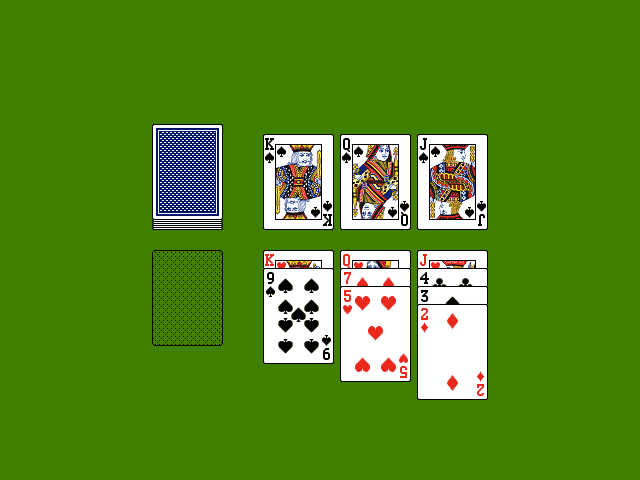 Guards are stacked on your Court cards to add attack and defence.
Guards can only be stacked in decreasing value
Guards are stacked on your Court cards to add attack and defence.
Guards can only be stacked in decreasing value
Guards act as both attack and defence. In the example of King+9, this
stack has a total of 19 defence and 9 attack (remember that Court cards have no attack,
but a defence of 10).
It is easiest to remember that if you count up the total value of the Guards on a
Court card, the defence will always be 10 more.
You may choose to discard the drawn Guard for strategic reasons; you may not wish to
severely cap the maximum attack you can build up (for example, a Guard of 4 on a
Court card can only gain a maximum of 9 attack—stacking cards 4, 3
& 2—less than even the basic defence of a Court card with no
Guards!)
Playing Instructions
Decide who goes first using any favourite method such as tossing a coin, rolling a dice, paper-scissors-stone or
whoever’s birthday is nearest. If playing multiple rounds, for two players the player who lost should go first,
but with 3 or 4 players who goes first should go clockwise each game.
On a player’s turn they can choose to do one of two things:
- 1. Defend
-
Take a card from the pile. (Note: Any time the pile runs out of cards, just flip the
discard pile. You should therefore discard cards face up)
-
A Court card (J, Q, K) causes you to miss
your turn, put the card on the discard pile and play moves to the next player
-
If it is a Guard (2, 3, 4, 5,
6, 7, 8, 9 or 10) then you can
choose to either:
-
Play the Guard by placing it on top of one of your
Court cards or an existing Guard, as long as
the value is lower than the exisiting Guard (though
not strictly sequential)
-
Discard the card for strategic reasons
Once either of these actions are taken play moves to the next player
-
A Joker can impersonate a Court card. Therefore if one or more
of your Court cards has been defeated, a Joker can be placed
on the back of the Court card and acts the same as a regular
Court card. If you have no defeated Court cards the
Joker must be discarded. In either instance, play moves to the next
player
 A Joker is played on the back of a defeated Court card. Once defeated, the Joker is discarded
-
An Ace allows you to both attack and defend (draw a card). Discard the
Ace card first and then decide if you want to
attack (if possible). Once you have done your attack (or
skipped it), draw a card.
- 2. Attack
-
To attack, you must discard some, or all (your choice), of the Guards attached to one of
your Court cards that add up to a total value equal to or greater than the total value of
one or more of your opponent’s Guards (if any) stacked on a Court card, up to
and including the Court card—thus defeating it.
Note: With 3 or 4 players, there is no order to who may attack who. You may choose to
attack any opponent you please.
Whenever a Court card is defeated, flip it over rather than discarding it. This avoids
having to pull them back out of the deck when playing multiple rounds.
Take this scenario as an example of attacking:
 An example play scenario with two players protected with multiple guards
Player 1 (top) has:
- King: 12 attack + 22 defence
- Queen: 0 attack + 10 defence
- Jack: 7 attack + 17 defence
Player 2 (bottom) has:
- King: 9 attack + 19 defence
- Queen: 12 attack + 22 defence
- Jack: 9 attack + 19 defence
Let us imagine that it is player 2’s turn. They have a few options open to them:
-
Their Queen is their only Court card with a total attack over
10 (7 + 5 = 12), thus player 2 could choose to defeat player
1’s Queen which has no additional defence and thus a basic defence of
just 10.
 Player 2 has spent their 7 & 5 Guards (12 attack) to defeat player 1’s Queen
(flipped over)
Player 2 has spent their 7 & 5 Guards (12 attack) to defeat player 1’s Queen
(flipped over)
By doing this however it would leave their Queen with no more
Guards and Player 1 could choose to defeat it with their King
(12 attack)
-
To avoid mutual destruction, player 2 could opt to first remove some
Guards from the opponent, without actually defeating one of their
Court cards.
The example play scenario again
Player 2 could spend their Queen’s 5 Guard, or the
Jack’s 3 & 2 Guards (5) to remove the
4 on the opponent’s King—lowering player 1’s
King to just 8 attack, or spend their Queen’s 7
& 5 Guards (12) to remove the opponent’s 8
& 4 Guards (12), which would look like this:
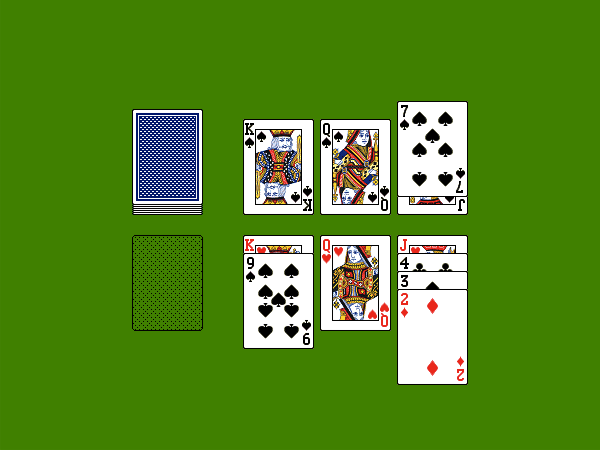 Player 2 has spent their 7 & 5 Guards to remove player 1’s 8 & 4 Guards on
their King
Player 2 has spent their 7 & 5 Guards to remove player 1’s 8 & 4 Guards on
their King
Now player 1 is left with very little offence.
You may only spend Guards from one Court card, and only in increasing value. That is, you
cannot use the value of a Guard in the middle or top of a stack, you must count upwards
from the last one.
When attacking, first discard your chosen Guards (all at once rather than one by one),
then discard the opponent’s Guards, and if the Court card was defeated too,
flip it over. If the opponent is using a Joker, discard it once defeated
After an attack is complete, play moves to the next player.
Variations
Here are some suggested rule variations:
- Allow same-value Guards to be stacked
-
Normally you can only stack Guards that are lower in value than each other. One variation to play
is to allow equal value Guards to be stacked (e.g.
8+8+4). There will be less discards, but it will also allow players to amass
massive attack / defence values, increasing the challenge.
History
I had the idea for this game in 1999, as a way to mimic trading card games like Pokémon
TCG with a regular pack of cards. The original principle was that a card could
be chosen to be either an attack card / monster, or as energy to power an existing attack card / monster. I hadn’t
tested the idea fully to work out the mathematics of play, however the concept did stay in the back of my mind until
the last couple of days on a holiday with a friend where we were playing a lot of
British Blackjack (my variation thereof that I’ve been
refining for the last 20 years) and I explained that I had an idea for a new card game that I had been working on.
Over the next couple of evenings, and some beer, we refined the concepts into a playable game.
The birthplace of Court Wars is The Square and Compass pub in
Matlock, Derbyshire on Saturday the 6th August 2011, should you wish to pilgramage there :P
Initially we gave court cards a high value of 20, but found that it was becoming near impossible to defeat a court
card and went around in circles just adding and removing guards. When we reduced this to 10, things played much
better. We were also using a hand, where cards the player did not want to play could be kept, but it seemed arbitary
and allowed a player to keep on to high value cards for a long time, making it a little fruitless to knocking out
their guards. Once we had gotten rid of the hand things played much quicker, however we noticed at the beginning of
the game that without any defence to start with we each lost a court card or two very quickly, so added in drawing
three cards at the start.
Where as the Joker was decided to mimic a court card early on, before that we had a rule that any court card you
picked up could replace a missing court card as long as it was the same type (King, Queen, Jack). Along with the
other rule changes happening we found that we could never outright win a game as the pile cycled quickly and would
keep drawing court cards.
The Ace rule came last (though we knew that the Ace card would have to be used as a special as it was mostly
worthless otherwise) but it took some debate to decide exactly what it should do. It wasn’t as simple as
“another turn” because of the attack / defend mechanic (early on you started every turn by taking a card and
then attacking afterwards). By simplifying turns into attack or defend, the Ace fitted better. We ended up
shedding a great deal from the design to hone it down to something far simpler and more consistent, and as a result
the balance sort of worked itself out. We were surprised by how well it played and we knew immediately when we had a
working game, rather than just messing around with a set of cards.
Thanks goes to Prenuntius for developing the game and John Drinkwater for play testing and feedback on these
instructions.